February 2008
Monthly Archive
The architects of Buenos Aires have left some of the most vivid impressions on the surface of this city. Stunning facades and architectural details are among the primary characteristics that create the beauty of Buenos Aires. The parks and plazas planned by landscape architects form yet another component of the city’s grace.
A brief architectural guide (pdf) provided by the city government of Buenos Aires offers this description:
Over the homogeneous grid of blocks and lots of Buenos Aires, the most varied and exotic architectures have been placed as layers, alternating the buildings of the original inhabitants and the signs of the different immigrant waves. Something of colonial architecture, the most varied historicisms, modernisms, architecture from the modern movement (specially a must-see collection of rationalists buildings), and good contemporary architecture alternates generating the most curious contrasts.
And for years Robert has been delighting us with descriptive, photo-filled posts about the architects of Buenos Aires, such as his latest on Pirovano. But Robert is packing his bags and moving off. At least we can look forward to learning about the architecture of Sydney and Lisbon!
Meanwhile, for fans of Buenos Aires architecture, Alejandro Machado has been creating a series of tributes to the architects of Buenos Aires (these sites are very image heavy and may be slow to load but are well worth the wait, just don’t try to open the pages all at once):
A walk down Billinghurst enables you to see the diversity of neighborhoods in Buenos Aires. The northern terminus of Billinghurst at Av del Libertador in Palermo are three grand mansions that are now the Spanish embassy and the ambassador residences of Saudi Arabia and Italy.

Billinghurst crosses into the edge of Recoleta and is lined with mostly unremarkable, contemporary apartment buildings whose only outstanding attribute is their location on the edge of Recoleta and Palermo.
At Av Cordoba the street changes significantly, becoming wider, and the quality of buildings is decidedly not as pretentious. You have entered Almagro. There’s a particularly intriguing structure at the juncture of San Luis, Billinghurst, and Tucuman. Looks like the architect had fun with this one.

Traveling further into Almagro and you’ll just a few blocks behind Abasto and in an old Jewish neighborhood. On one corner is a kosher butcher.

Does anyone know what the word Ufarasta means? I’m assuming it’s Hebrew.

Back to the walk: cross the train tracks, then cross Av Rivadavia where Billinghurst changes names to Virrey Liniers. This large house at the corner of Venezuela (Virrey Liniers 541) is undergoing a careful renovation. It’s quite a massive place. The renovation work continued along the side of the house, too.

I’m a little worried about this place (below) at Mexico 3401, a large corner lot all boarded up….looks like a spot ready for demolition.

Remember the embassy and ambassador residences at the other end of the street, some 37 blocks to the north? Here’s the contrast at the edge of Boedo.

This house isn’t empty. People live there and a family of four, plus dog, live under the highway overpass just beyond this house.
But this isn’t reflective of Boedo, which is a pleasant area, but I’m sure there are not any ambassador residences in Boedo.
I don’t know if anyone offers a literary walking tour of Buenos Aires, but if you read Spanish then you can grab a copy of Al pie de la letra: guía literaria de Buenos Aires by Alvaro Abós and create your own walking tour.
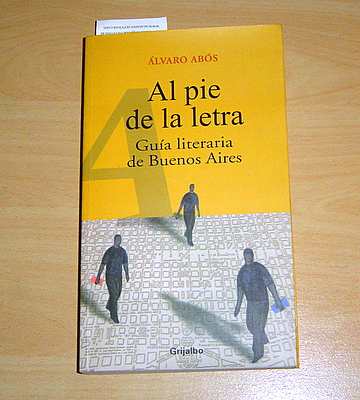
I bought this book a few years ago and have enjoyed it, dipping back into it time and time again. The book also has a wonderful design with many little line drawings.
Yesterday when I was browsing the bookstores on Corrientes, I noticed that Librería Libertador has copies of this book for just 10 pesos.
I was quite surprised to see this book there. This type of book should continue to sell and I noticed by checking online that it’s still sold for 32 pesos elsewhere, so I’m not sure how it got into the discount bookstores unless this is an old edition. My edition is from 2005 but the material in this type of book doesn’t really get dated. Anyway, if you’re in town, like Argentine literature, & don’t already have a copy, then you might want to swing by Corrientes. While you’re there you will undoubtedly find other bargains. I left Librería Libertador with 7 books and 54 fewer pesos.
I’ve been working recently with part-time Buenos Aires resident Peter Robertson to help get Issue 2 of the International Literary Quarterly ready. There is some really wonderful writing in this issue, so if you’re into literature then you must check it out.
While I’m on the topic of international literature and journals, I want to point out an e-journal that I had an instrumental role in launching in 2003 when I ran the digital library initiatives at the University of Miami – Anthurium: A Caribbean Studies Journal.
Searching for that perfect book in English during your stay in Buenos Aires? The good folks over at Argentina’s Travel brings you “Buenos Aires’ Brilliant Bookstores: Finding BA’s Best English-language Book Selections.”
As a literary type I spend way too much on books. Even when I was a librarian and had access to a library of millions of books, I still spent about us$50 a week on my own books and magazines. (My book budget is now a lot lower, down to around 50 pesos a month).
The guide to English-language bookstores, written by Natalie Gourvitch, starts off with my favorite: Walrus Books, which has the best selection of English-language literary fiction in Buenos Aires.
My criteria of quality for evaluating articles about bookstores in Buenos Aires includes examining what is said about El Ateneo Grand Splendid. Yep, it’s a beautiful place but it’s actual inventory isn’t great. Natalie writes, “While El Ateneo, as is true for chain
stores like Cuspide and Distal, is great for finding popular romance/thriller novels with a spattering of Shakespeare thrown in for good measure, it lacks a large selection of classics and quality modern fiction titles.” I assume that she’s talking about the English-language books but I never been very pleased with El Ateneo’s selection of Spanish-language titles, either. I go there all the time to browse around but rarely do I buy anything there.
I’m reminded of my quest last year: Searching for Galeano in the bookstores of Buenos Aires, a odd tale in which it was actually easier to find books in English translations than in the original Spanish.
Football is one of the most vital aspects of life for most men in Argentina. But I must admit that football in Argentina is a topic in which I only know the basics. Fortunately, Pitch Invasion, a site devoted to “exploring football culture around the world” has prepared an introduction to Argentine Football that has a superb graphic (developed by billsportsmaps.com) for figuring out the colors and locations of the football clubs in Argentina.
And if you want to follow Argentine football in English then follow along at Hasta El Gol Siempre.
There are many fun things to do in Buenos Aires and, on this Valentine’s Day, here are some ways of falling in love with the city of Buenos Aires:
- Enjoy the afternoon on a shady bench in Plaza San Martín, with a backdrop of aristocratic palaces and the periodic appearance of historically dressed militars marching towards the Malvinas memorial.
- Hunting down the distinctive garages, those characteristic structures from the city’s golden age that remarkably stylize the concept of the parking lot.
- Spend hours in a classic café talking with a friend, reading, or just observing porteño society.
- Linger along the streets, admiring architectural details, like decorative tiles and stunning doorways, designed and crafted by architects and contractors who proudly left their names on the facades.
- Venture away from the busy avenues and stroll down cobblestone streets in a quiet barrio, where you might even unexpectedly stumble onto a film set.
- Witness the seductive dance of tango in a milonga, or join in if your feet allow.
- Seek out an antique pocket watch in a charming store on a hidden block in the city’s core.
- Discover Argentina’s many great painters- Berni, Quinquela Martín, Xul Solar – and wonder why you’ve never heard their names before coming to know Buenos Aires.
- Wander down a side street between Puerto Madero and downtown and be astonished at the sight of an eternal flame below a painting of the mythical figure of Eva Perón that adorns one corner building.
- Walk the streets of Buenos Aires, just choose a street and walk….walk slow.
If you want to fall in love with Buenos Aires, or already are in a passionate affair with this city, I will be releasing a series of e-books that I’m labeling the Walking Buenos Aires series. Each e-book also will be available in a print format for those of you who prefer your books on paper. The first volume will be out soon. Stay updated on this series by heading over to walkingbuenosaires.com and leaving your email address.
Recoleta Cemetery is one of those places where you always learn something new and Robert’s AfterLife site gives a fresh dose of those creepy yet beautiful tombs. You really should be following that site if you’re not already.
Back in 2006 I wrote a post titled terrorist, assasin, avenger. As blogging goes, I’ve actually forgotten about that post even though the anarchist movement in Buenos Aires is one of my favorite topics of reading. The other day Robert asked if he could use part of that post to highlight the tombs of the victims, Ramón Falcón & Juan Alberto Lartigau, located in a spectacular corner of Recoleta Cemetery.
Ituzaingo is a quiet, shady street just beyond the southern edge of San Telmo. Nothing suggest this street as the source for a social movement in 1907 that mobilized 10% of the population of Buenos Aires.
The strike started in September 1907 in one building where the rent increased by 47% in a single month. The strike then surged through San Telmo, including more than 750 buildings within a month. Working class tenants throughout the city joined the strike and more than 2,000 buildings – representing more than 120,000 people – had joined the movement by the end of 1907.
Wages keeping track with inflation is always a problem in a growing economy, a topic familiar to anyone living in Buenos Aires today. By 1907 rents had been rising steadily for two years, yet wages were not increasing for many workers.
A side note to this story: the two hundred block of Ituzaingo where the strike started no longer exits. Ituzaingo street now starts at the 500 block, the earlier parts of it were cut off by Parque Lezama and construction in La Boca.
There are a number of fascinating studies about working class activism during this period of Buenos Aires history. A particularly detailed article is by James Baer, “Tenant Mobilizatin and the 1907 Rent Strike in Buenos Aires”, The Americas, Vol 49, Issue 3, January 1993, pp 343-368.
The development of organized labor in Argentina, based on an immigrant workforce that brought both socialist and anarchist tendencies from Europe, is one of the primary forces that shaped the country during the 20th century. Much of the middle class in Buenos Aires today sigh in frustration over the antics of the labor unions and worker movements. But the historical origins of that populism is largely responsible for the eventual formation of the modern middle class in Argentina, a reminder that forces today are shaping the Argentina of tomorrow.