December 2006
Monthly Archive
Last night marked the second anniversary of the fire at a concert in the República Cromagnon nightclub that killed 194 people.
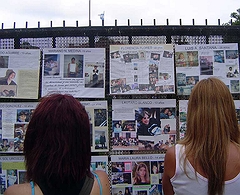
Taped to the barricade in front of Casa Rosada were reminders of the lives that were lost that night. The depth of the tragedy is apparent in the ages of the victims shown just in this photo: 28, 24, 20, 19, 14, 13.
Politics aside, I still have a lot of compassion for the families and friends of those who perished. The anniversary of a person’s death is always difficult. The end of December will always be hard for these families. Unfortunately, they will never again have a truly happy new year.
When I arrived at the remembrance late yesterday in Plaza de Mayo the families were in the Cathedral for a memorial mass. Stretched across the road in front of the Cathedral was a banner with more photos of those who died.
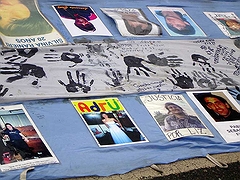
After the mass a few speeches were given in the center of the Plaza. A lot of anger stemming from their grief has been directed at the city government for failing to enforce the code violations at the club. Yesterday, before the speeches in the Plaza started, a dozen police in riot geared lined up in front of the Palacio Municipal. But, during the speech, the police officials made a change and quickly replaced the riot squad with half-a-dozen regularly uniformed policemen. It was an appropriate decision. While there were a couple of left-wing political groups in the plaza, there were none of the hardlined piquetero groups. Nobody had their faces covered or carried large sticks as in so many marches.
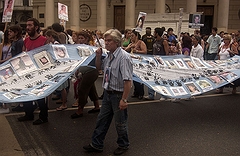
People simply carried signs or banners with images of their loved ones as they marched down Av de Mayo on their way towards the location of the fire in the neighborhood of Once.
During the speeches I noticed a few girls take a seat on the curb in front of the Cabildo. Two of them carried signs with the photo and a name of a friend that died in Cromagnon. One girl said something to another and then both girls carefully turned their signs so that their friend’s photo faced inward. I didn’t understand at first, but then I realized….you’re 20 years old, how hard it must be to sit there and look at the photo of your dead friend.
Thirty of December, the next to last day of the year. Friday brought the hottest day of the season so far. Summer has arrived in Buenos Aires and the city empties as thousands of porteños drive towards the beaches. Overnight storms carried a welcome cooling but the heat will soon be back.
This morning I was in need of freshness. I found it walking along Av Brasil. For those unfamiliar with Buenos Aires, Av Brasil is in the southern part of the city and starts near the lower edge of San Telmo and passes through the barrios of Constitución and Parque Patricios.
The sky was still cloudy as I got started around nine. The man running the nursery on Brasil in San Telmo was just setting out his plants for the day.
Passing through Constitución
Crossing into Constitución I decided to walk through the historic train station rather than around it this time. The exterior is beautiful but the massive interior is quite breathtaking in its own way. Even though a recent renovation has resulted in significant improvements, the main hall remains rather dim. Still it’s quite a sight.
Whenever I walk out of Constitución station and pass by the shops on calle Lima or Brasil, I indeed feel like I am in Lima or, perhaps, Caracas. For a couple of blocks surrounding the station, the whole area is filled with stores selling cheap goods. (But not everything is cheap, for the first time I noticed that there is a huge Frávega electronics/appliance store on Av Brasil). The area has a noisy, hectic pace that reminds me of more distant lands.
Evidently a lot more people have that far off feeling in this area. Maybe it’s the train station bringing in travelers. Stretching along Av Brasil is a series of dilapidated hotels with names that try to strike an exotic feel: Casablanca, Bahia de Brasil, Esquel, Asunción, Sol y Luna. At one time, I assume this must have been a prime tourist section of the city though now these hotels cater mostly to immigrants to Buenos Aires from surrounding South American countries.
In keeping with that one-time tourist theme there’s even a place whose sign advertises itself as a “restaurante turístico”. In this barrio? The tourism revival for Constitución still seems a long ways off.
“Destroyed”, but lovely
The barrio of Constitución, once you get a few blocks away from the train station, is quite appealing in a an unusual sort of way. At the corner of Brasil and San José are four, large weeping willow trees. This section of Brasil is lined with early twentieth century buildings which indicate that this was once a prosperous area. (Remember that an Argentine president once lived on Av Brasil). Yet the buildings are now falling apart, though a few manage to retain a glimmer of their former style.
There is also a rustic, tough feeling to the barrio. Pasted on the wall of a 24 hour hot dog eatery is an advertisement for a boxing match in neighboring suburb of Avalleneda. Inside the diner is room for only two tables, four stools in front of the counter, and a pool table with a red felt top.
A Street Unknown
I know most of the streets in this part of the city or, at least, have vaguely heard the name. So, it’s a pleasure to come across a new street, particularly when it’s one of those cobblestone roads that extend for only two blocks. This one had a peculiar name, that if I had heard it before, I know I would have remembered it: Mompox. I’m curious to find the origin of that name. Some place I’ve seen a book that describes the history behind the street names of Buenos Aires. Yet, another title to be added to my collection. (Ok, a quick Google search tells me that Mompox has something to do with Colombia and Spanish colonization but I still don’t know how a tiny street in Buenos Aires came about to be called that).
Whether it has any relevance or not, if you walk directly down Mompox to where that street ends at Av Brasil then you will find yourself in front of the Iglesia Cristiana Evangélica. Later in the morning I saw more evangelicals wandering around Av Brasil, all dressed nicely, carrying black bags, Bibles, and knocking on doors. I kept walking.
Into Parque Patricios
Crossing Av Entre Rios one passes from the barrio of Constitucion and into the barrio of Parque Patricios. Initially, I had lost my bearings. At this point Av Brasil widens from two lanes to four and the area becomes modern, quite boring, and sterile. To my left was some large industrial-like complex, a factory of some sort that seem to have been surrounded by a green space, but oh so bland. It seemed that no one had ever lived on this part of Brasil. Turns out that it was not a factory at all, but the word sterile was quite appropriate. The huge complex was the Hospital Nacional de Pediatria Garrahan. I’ve often heard of Garrahan hospital on the news due to the many strikes and problems at that facility but never realized it’s exact location.
Looking over to the south I realized that the hospital and park was located just behind the old prison on Caseros. I’ve seen this area from my visits to the prison (you’ll have to read about that to understand) but didn’t realize that this was the other side just down the street
The End of Brasil
At about the 2600 block, Av Brasil returns to a nice, shady cobblestone street with an abundance of early twentieth century buildings that are in decent shape.
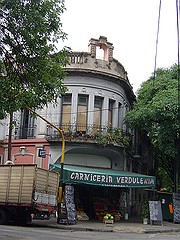
Like most of Buenos Aires the interesting, older buildings are mixed in with newer places, sometimes houses, stores, garages, or maybe a warehouse. Poking out of the doorway of one warehouse I saw a foot, a bare foot hanging out over the sidewalk. Coming into view was the rest of the person, a bearded man around twenty who was in a deep sleep. He didn’t quite look homeless. Evidently he had a late night. Then I came across another surprise. In the very next doorway was obviously the man’s friend, a shirtless guy about the same age who also was sleeping through the morning. (Later in my return trip down another street I saw these same two guys stumbling around, evidently they woke up and were trying to find their way home).
At the 3200 block of Brasil the traffic pattern suddenly changes. What had been a two-way street suddenly (without any signs that I saw) became a one-way street going east. The very next block is the last of Av Brasil, which ends at Sánchez de Loria. There’s an interesting looking restaurant at that corner, La Taberna de Roberto. I’ve been by there in a taxi late night and it was crowded, always a good sign. This Saturday morning all the staff was out sweeping the sidewalk, taking deliveries, and preparing for the day.
I spent more time wandering further west into the barrio of Boedo, where I took quite a few photos. Boedo is full of incredibly charming places. But I’ll save those for another post.
A recent issue of Ñ had the usual end-of-year review of books published in 2006 with a list of recommended readings. Here’s the list of foreign books that Ñ recommended to its Argentine audience. I’m including the English title when I know it and the Spanish title for all works. The titles are listed in the order provided by Ñ:
Brooklyn Follies by Paul Auster
Kafka on the Shore (Kafka en la orilla) by Haruki Murakami
The Black Book (El libro negro) by Orhan Pamuk
The Sweetest Dream (El sueño más dulce) by Doris Lessing
Jacobo el mutante by Mario Bellatin (Mexican-Peruvian writer, unavailable in English)
La pintora de la reina by Genevieve Chauvel (translated from the French; I don’t believe it’s available in English)
A Star Called Henry (Un héroe llamado Henry) by Roddy Doyle
La mesera ere nueva by Dominique Fabre (translated from the French, not available in English)
(El viento de la Luna) by Antonio Muñoz Molina (Spanish author, I don’t believe this title is available in English
Lunar Park by Bret Easton Ellis
I consider myself a very well read person but have only read five of those writers (Auster, Murakami, Pamuk, Lessing, and Ellis). I am familiar with Doyle but have never read anything by him. All the other writers are new to me. Of course, a limiting factor in what Ñ can recommend to its readers are only works that have been translated into Spanish. But, it’s nice to learn about some writers that are new to me. Lists like these help me realize how little I know about contemporary literature from non-English speaking countries. From the above list, my personal recommendation is Kafka on the Shore. Ok, yeah, Murakami is from Japan but he’s hugely popular in the U.S.
Argentine Novels
Here is the list of Argentine novels that Ñ recommends from 2006:
Tartabul by David Viñas
Punto final by Andres Rivera
Arte menor by Betina Gonzalez
Diario de la rabia by Hector Libertella
Sí, soy mala poeta pero… by Alberto Laiseca
La educatión de los sentidos by Miguel Vitagliano
El conquistador by Federico Andahazi
Bolivia construcciones by Bruno Morales
La batalla del calentamiento by Marcelo Figueras
Leer y escribir by Ariel Bermani
This issue of Ñ also includes dozens of more books by Argentine writers in various types of non-fiction as well as more fiction.
Ñ reports more than 16,000 titles being published in Argentina during the past year. Some of these works will find a reading public in other Spanish-speaking countries. Yet, that’s a lot of writers whom, mostly, will never find an audience outside of Argentina. I, for one, am quite impressed by the quality and quantity of publishing in Argentina. One of my blogging goals for the upcoming year is to examine more Argentine writers, helping a little to bring a tad more recognition to the many voices of this country. Considering the fact that few titles are translated into English these days, reading Spanish opens up an entirely new world of the imagination. These books are readings not just for Argentines, but for all of us.
 Last week I received news that this blog has been accepted into the 9rules network of weblogs. I’m very excited about that and consider it a big honor.
I’ve long thought of 9rules as the best source for blogs with really good content and am, indeed, proud to say that I’m now a member. If you’re not familiar with 9rules, then swing over to browse the 9rules sites.
As my second year of blogging about Buenos Aires nears an end, I want to thank everyone who has been reading this site. I’m excited about the upcoming year. I have a long list of topics about Buenos Aires to write about, a couple of ideas for new series of postings, and more to share with you.
How did I not know this?
While wandering around the coast of Argentina I saw several buildings with the name Stella Maris. Earlier in the year in Miramar I saw a couple of apartment buildings with that name, Stella Maris I and Stella Maris II. In Claromecó I saw more buildings with that name. Heck, even around Constitución Plaza in Buenos Aires there is a building with the name Stella Maris. So, I started to ask around, “Who is Stella Maris?” No one could answer my question. Of course, I never thought to Google the name or thinking about the origin of the words.
My thinking cap wasn’t on. Somehow, I had it in my mind that Stella Maris must have been some faded Argentine movie actress, rather like Mirtha Legrand.
Well, I was way wrong. But, when we were down in Dunamar I was reading about the history of Claromecó and found my answer. Stella Maris, Latin for star of the seas, is the ancient term used by seafarers for the Virgin Mary. That explains why the term adorns so many buildings in seaside communities. (Obviously, I grew up Protestant in a land-locked state).
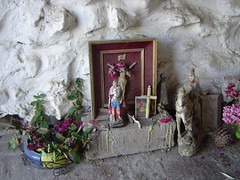
In Claromecó there used to be a grotto devoted to Stella Maris. While that grotto no longer exists, I did take this photo in a shrine to Our Lady of Lourdes that is on the outskirts of Claromecó.
I was at Abasto yesterday and the mall was packed with people, which isn’t surprising since it’s just before Christmas. But then I noticed that very few people were carrying shopping bags. From a quick look around, it seems like only 10% of the people had any kind of shopping bag…as an indication that they had actually brought something at one of the stores. I wasn’t sure what to make of this observation. Why be at the mall just before Christmas if you’re not buying? Then again, I was there also without a shopping bag and didn’t buy anything…just went there for a movie. And the movies were very full as usual on the weekend. Of course, I know that Argentines – even in the best economies – do not have the Xmas gift giving obsession of people in the U.S. Of course, I’ve not even started my own Xmas shopping yet. I’ll go again in a few days and see if things are any different.
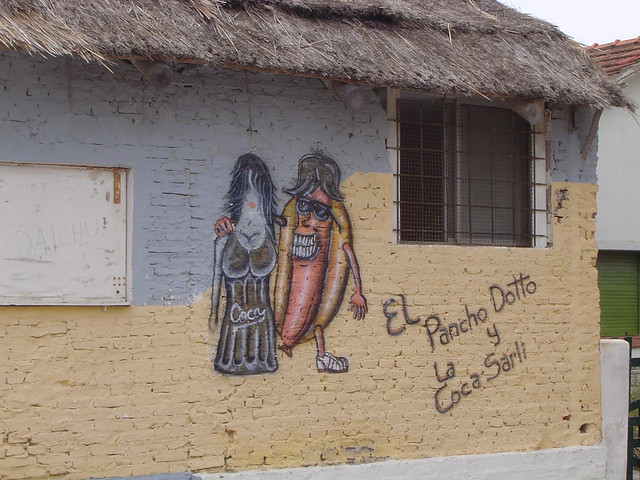
Saw this drawing on the side of an abandoned building on the Argentine coast. I’m told that it’s rather funny to anyone familiar with Argentine pop culture. (Indeed, I think a book about Argentine pop culture would be a best seller to the growing expat community).
Here’s an attempt at an explanation (readers: please feel free to elaborate):
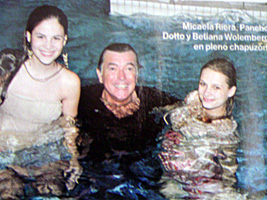
Pancho Dotto is the name of a guy who runs the leading modeling agency in Buenos Aires, Dotto Models. From his photos Pancho Dotto seems to be one of those media celebrities with a lot of dark hair and fancy suits. A pancho is also slang for a hot dog (see photo).
Isabel Sarli is an Argentine movie actress from the 1960s and 1970s, mostly known for her nude scenes. You occasionally can catch one of her old movies on late night cable TV here in Buenos Aires where she surely will be swimming around on her back. (Here she is in the April 1960 Playboy). She was nicknamed la Coca. Why? Her addiction to Coca-Cola or because her body was shaped like an old-fashioned Coca-Cola bottle? (see photo).
Update – For readers not familiar with Pancho Dotto, here’s a photo I saw this weekend of him in his usual environment:
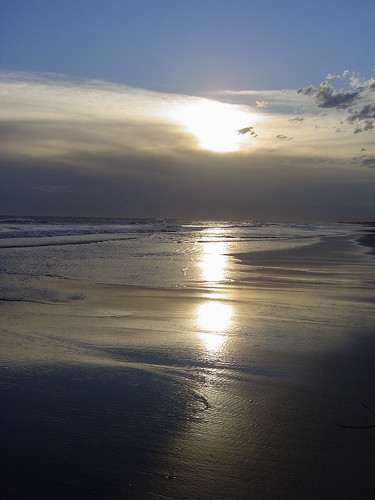
Just returned from a week on the Argentine coast. Stayed in a small village called Dunamar, which is on the other side of Tres Arroyos, about 8 hours by bus from the Retiro station in Buenos Aires. There are a lot closer beach towns but we accidentally discovered this place last year and decided to return again for my birthday this month. Only about 15 families live in Dunamar throughout the year. There are just a few dozen houses in Dunamar and I’m told that they are all already booked for January. Dunamar was founded in the 1950s by Ernesto Gessell, brother of the guy who founded the coastal resort town of Villa Gessell. In a way, Dunamar is a very tiny version of Villa Gessell. Located in a woodsy area with a broad beach that is deserted during the off-season. It’s one of those lovely beaches where you can walk for kilometers and not see anyone. Plus, you can see both the sunrise and the sunset on the same day. All very nice and relaxing.
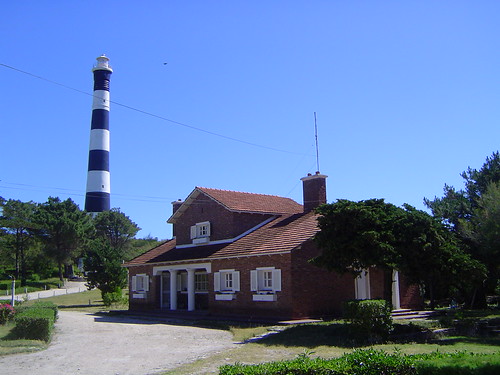
The drawback to Dunamar is that it’s located right next to the horrible beach town of Claromecó, which has a lovely name but is rather blah. But, Claromecó has a wonderful lighthouse.
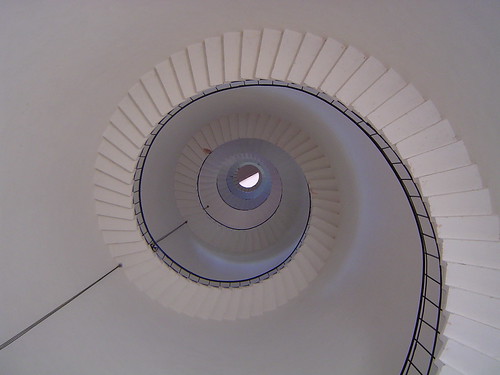
I’ve been to the top of many lighthouses and have always enjoyed them. But, somehow, the wide, open nature of the spiral staircase in this particular lighthouse really affected my vertigo and I had to backtrack my way down before getting to the top. There’s also an incredible echo within the lighthouse. That stairway is beautiful but not for those with a fear of heights.
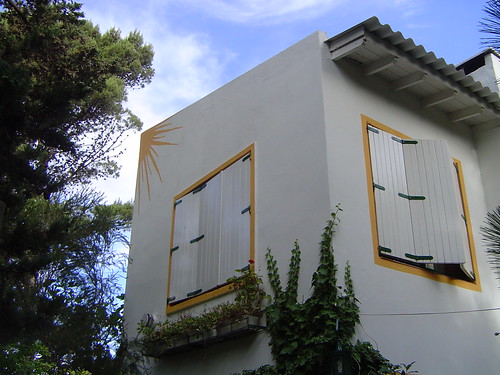
And here’s the house that we rented in Dunamar for less than 100 pesos a night (off-season rates).
A shocking discovery
Walking along the beach at dusk one evening we came across something that really startled us. In the distance we saw an object in the surf. At first, I thought it was a person or a dog but as we got closer we didn’t see it anymore. So, we figured it was nothing or we hoped that it was nothing since we didn’t see either man or animal get out of the water and onto the beach.
Then we saw it again, bobbing in the waves. It looked, initially, like a black garbage bag but one that was really large. We stared at it for a few seconds. My imagination ran away. What large item could be in this garbage bag? Honestly, the thought that came to me: a body. Then the bag started moving. For just a second, the thought came to my mind that the person was alive. I felt like I was in some opening scene of CSI. Then, with relief, we realized that it was a seal or something. Turns out that it was really fun to watch the fellow move along the shoreline. He would catch the waves and surf towards the beach then swim back out.
Later, walking along the beach, we see this huge object on the horizon. We get closer and closer, thinking that it’s another sea animal but this one wasn’t moving. We were afraid that he was dead, having beached himself. But then he got up and walked a few steps before collapsing again. We inched closer for a better view.
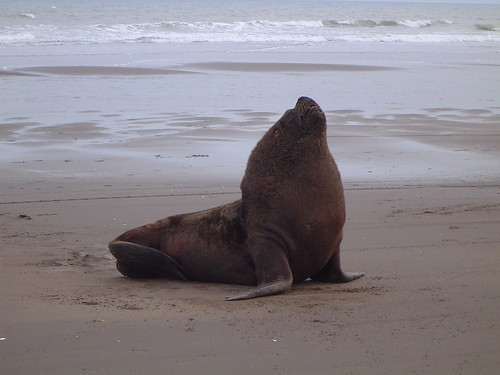
Back in Dunamar, someone told us that it was a lobo marino. That translates to sea wolf but I think these animals are known sea lions in English. The photo doesn’t really give a good sense as to the massive size of this fellow…think small car.
Down in Peninsula Valdés you expect to see all sorts of things like this but I didn’t expect it this far up the coast. Last year we didn’t see anything of the sort around Dunamar. But this year was an enjoyable surprise.
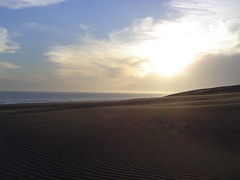
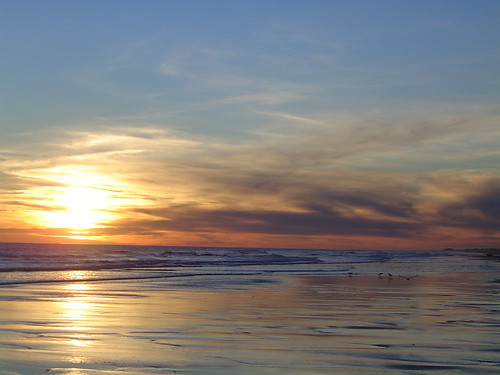
Finally, here’s another sunset to close out this post. There are a couple of more interesting things I’ve learned on the trip that I’ll share later.
Heading down to the Atlantic coast of Argentina for a few days of relaxation. Taking along some good books, the iPod, and looking forward to being away from the Web for a few days.
When I get back to the city next week, maybe, I’ll have some new photos from the beach.
For some reason I was fascinated with this set of windows from an old, abandoned factory in Barracas.
Next Page »