October 2006
Monthly Archive
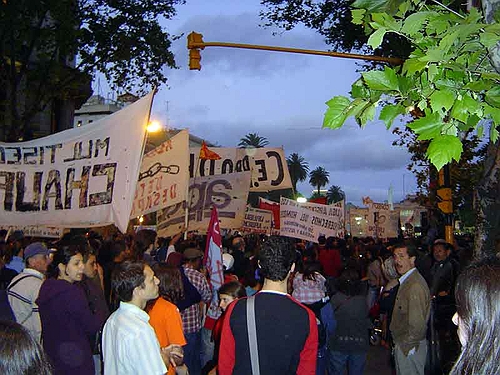
Again on Wednesday evening several human rights groups led a march down Avenida de Mayo from Congreso to Plaza de Mayo to protest the disappearance of Jorge Julio Lopez. More info (in Spanish) can be found at www.30anios.org.ar, one of the organizers of the march.
18 of October: a month after 77 year-old Jorge Julio Lopez disappeared, a key witness in the recent trial against former police official Miguel Etchecolatz, who was sentenced last month to life imprisonment for his involvement in the last dictatorship in Argentina.
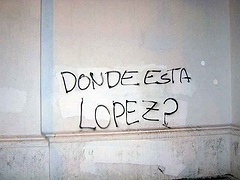
At one point during the demonstration I turned away from the crowd and saw a person in a black hood spray painting the words “Donde esta Lopez?” on the walls of the Cabildo. If you look closely at the photo, you can see the layers of white paint that covers graffiti from past demonstrations. Four policmen stood just within the closed gate of the Cabildo, clearly knowing that it’s easier to re-paint the Cabildo than try and stop the vandalism.
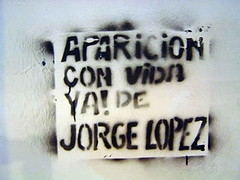
A few minutes earlier, across the street, a couple of girls sprayed a stencil on the walls of the Palacio de Gobierno de la Ciudad. The city used to station a line of riot police in front of that building but, this year, the city seems to have pulled most of the police away from that area during the demonstrations.
This particular march was not quite the carnival that was the march of a couple of weeks ago that also focused on the disappearance of Lopez. I still need to do a write up on that one.
The crowd last night was quite different. I didn’t stay to see the entire protest line, which stretched quite far, but last night’s demonstrations didn’t have the mass of poor residents bused in from the provinces. Overall, last night’s crowd was more middle class and working class than a lot of the demonstrations. There also was an extremely large number of students.
It’s not everyday that the body of a famous historical figure rides through the streets. So, I took a break yesterday and walked over to Paseo Colón for the sendoff for Perón. The reburial of his body from the Chacarita cemetery to an expensive mausoleum in San Vicente, south of Buenos Aires, has been well covered by an article in the New York Times and elsewhere.
Tuesday morning the coffin of Perón was transported from the cemetery to the headquarters of the CGT labor union, the bastion of all things Perón. It was a very manly affair. The blocks surrounding the CGT were filled mainly by working men, most wearing hard hats. An odd sight that I should have photographed was the dozens of these guys lined up on the massive steps of the University of Buenos Aires School of Engineering, located across from the CGT. They were a contrast to the students I normally see around there.
Some workers took a rest while they waited.
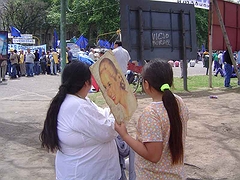
I estimate that 90% of the crowd were men from the labor unions. About 5% were media and the occasional person like myself who just came by for the spectacle. The remaining 5% were the loyal Peronist, like this mother-daughter pair with the picture of Evita, which they claimed was actually signed by Evita herself.
When it finally came time for the long journey from the CGT everyone jumped to their feet, ran onto Paseo Colón, climbed statues, and pushed for position while singing the Peronist anthem.
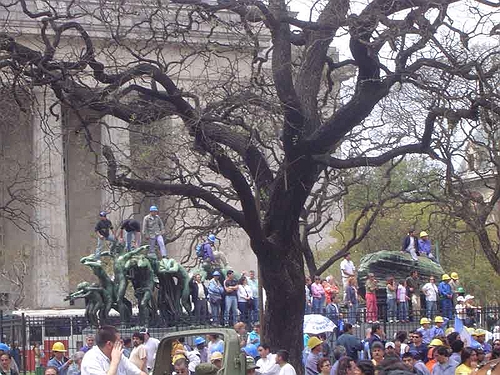
It was a false alert as it was only ex-president Duhalde and his wife Chiche walking down the street.
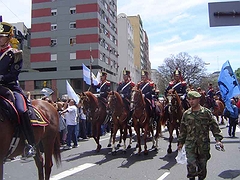
Then came an honor guard, trying to make space through cheering crowd :
The crowd surged when Perón’s casket was wheeled down the street. Until then I had a good view but was immediately swamped by dozens of people making their way towards the remains of Perón. Riding atop Perón’s casket were Hugo Moyano and other millionaires labor union leaders with big smiles on their faces.
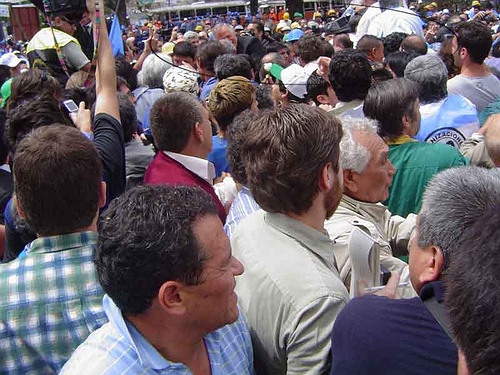
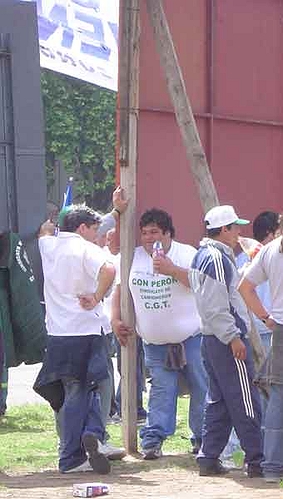
As mentioned by fellow BA blogger Ian, the day’s events turned ugly once the procession arrived at the new mausoleum. It’s really not surprising considering that some of the guys were well on their way to drunk by midday, like this guy in the white CGT t-shirt guzzling cheap wine out of a tetra pak.
One of the exciting aspects about living in a city such as Buenos Aires is encountering the unexpected. Walking home at night along Defensa through San Telmo is always an experience worth savoring – the cobblestone streets, the old facades, the sounds of tango around Plaza Dorrego.
Last night I came across something entirely different. As I walked under the highway overpass I noticed a protest march further down Defensa, banners and flags waving in the air accompanied by the sound of drums. An odd location for a march, I thought. Getting closer, I could tell that the rhythm was not the usual snare drums of the piqueteros but an entirely other beat.
Crossing Garay I then saw two tremendously large flags – red, yellow, and green – dominating a group of about thirty dancers and musicians heading down Defensa towards La Boca. They carried banners protesting the forced closure of the Movimiento Afro Cultural located in Barracas at Herrera 313, .
It was a reminder that I should always carry a camera with me in Buenos Aires, but I didn’t have mine. It was certainly the most colorful protest I’ve seen in Buenos Aires, almost like a carnival parade. The women dressed in flowing skirts, bare midriff, and silky tops danced exuberantly while the men played all sizes of drums.
The march was halted by police at the corner of Defensa and Brasil, just in front of El Hipopotamo café. The police would not let them march any further down Defensa. After a while of dancing and playing, the group picked up their instruments and crossed Av Brasil to gather once more in Parque Lezama where they continued playing and dancing.
One of the things I don’t like about working more these days is that it leaves little time for blogging or even reading the almost 400 blogs that I have in my bloglines. There are a lot of postings that I want to write about but just don’t get around to it. So, I have a backlog of ideas and topics for blogging that might find their way here someday.
Meanwhile, I wanted to point out a couple of interesting posts that I saw elsewhere. The Magical Urbanism blog has some really great postings about urbanization and Buenos Aires. See the cartoneros of Buenos Aires and a Monday afternoon at Argentina’s largest landfill. Then work your way back on that blog for some more intesting posts.
Also, Paterna over at aguafuertes 2004 wrote recently about a topic that I need to write more about: the recent disappearance of Jorge Julio López. Some highly questionable and politicized comments by Hebe de Bonafini, leader of the Madres de Plaza de Mayo, were made about his disapperance.
Last night while watching TV I saw an announcement of a march this evening by the Abuelas de Plaza de Mayo and a splinter group of the Madres, the Madres de Plaza de Mayo Línea Fundadora. See the Línea Fundadora page announcing the march.
I’m to Av de Mayo to see what’s happening….then it’s off to the coast for a couple of days this weekend. I’ll try to post next week about the march tonight.
« Previous Page