December 2005
Monthly Archive
The short story dominates Argentine literature. These stories often are not based in realism but in a fantastical realm that examines the meaning of identity and mortality. Borges is the writer that most often comes to mind. But before Borges there was Horacio Quiroga (1878-1937), who unfortunately rests in obscurity (at least among non-Spanish readers).
Quiroga is usually compared to Poe for his dark and macabre stories. Quiroga’s stories often are set in the jungles of Misiones, the northeastern province of Argentina where Quiroga settled midway through his life. Also like Poe, Quiroga’s writings served as a model for other authors. The Cambridge Companion to Modern Latin American Culture calls Quiroga the most important short story writer in Latin America at the turn of the last century: “His terse style, dramatic and often violent situations and his search for the extremes have made him a source for contemporary short-story writers.”
Though born in Uruguay Quiroga can still be considered an Argentine writer. After traveling to Paris he turned to Buenos Aires where he was active in the city’s vibrant literary scene during the early 20th century .
Quiroga lived a life that was as dark as his own stories. Surrounded by death and violence, his father died suddenly when he was young. Barely into his twenties, Quiroga himself accidentally shot and killed his own friend. Quiroga’s first wife committed suicide when he was thirty-seven.
It was after her death that Quiroga entered his greatest period of story writing. In 1917 he published Cuentos de amor de locura y de muerte. Two years later he published Cuentos de la selva, a set of stories for children, which are still popular today.
In 1937 Quiroga learned that he had cancer and chose suicide himself, ending his own life by swallowing cyanide.
Many of Quiroga’s works are available online in Spanish:
His works are more difficult to find in English. There is not yet a collected set of his stories in translation but two volumes of stories have been translated:
It also is possible to purchase Cuentos de amor, de locura y de muerte in Spanish from Amazon if you’re in the US or elsewhere. Of course, in Argentina, Quiroga is pretty easy to find in Spanish.
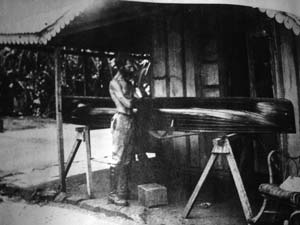
Quiroga was also known as a good craftsman with his hands, an experienced carpenter who built his own house in Misiones. The photo (from the Archivo General de la Nacion) shows him working on a canoe. The house, located in San Ignacio near the Jesuit missions, is now a museum. In addition to writing, Quiroga was an accomplished photographer who was among the first to visually document the now famous Jesuit missions.
December 31, 1878 ”“ the date of Quiroga’s birth. So, as you toast the new year tonight, remember a good cheer for the tormented life of a man who captured his despair in prose.
Over the past couple of days I’ve been casting about for a book to read and then realized that today, December 28, would have been Manuel Puig’s seventy-third birthday. So I’ve decided to pick up Kiss of the Spider Woman (El Beso la Mujer Arana).
Manuel Puig, who died in 1990 at the age of 57, is one of the few Argentine writers to achieve wide-spread international recognition, mostly for the 1985 film version of this novel. Nominated for four Academy Awards, William Hurt received an Oscar for Best Actor. After Puig’s death the novel/movie became a Broadway musical and won seven Tony awards.
Puig was a child of the pampas, born in 1932 in General Villegas which sits on the western edge of Buenos Aires province. It’s fitting that Puig’s fame came from a movie since cinema formed the most significant influence on his writings. His early aspirations were actually to be a filmmaker and he moved to Rome to study cinema.
His first novel Betrayed by Rita Hayworth (La Tracion de Rita Hayworth) is about the movies and people’s lives in rural Argentina. His second novel Boquitas pintadas, translated into English as Heartbreak Tango, also was about life in his hometown in the pampas.
In an interview Puig talks about writing:
I write novels because there is something I don’t understand in reality. What I do is locate that special problem in a character and then try to understand it. That’s the genesis of all my work. Because of my unconscious defenses, I am incapable of facing the problem directly. There are obstacles that impede me from doing so. Yet I can do it through a literary character. It’s easier! And since all of my problems are rather complicated, I need an entire novel to deal with them, not a short story or a movie. It’s like a personal therapy. There is no freedom in that election. It’s not that I choose to do it, but that I’m forced to. It has to be a novel because I need a lot of space. It’s an analytical activity, not a synthetic one.
Puig was fortunate in having very good English translators. Four of his less well-known novels are translated by Suzanne Jill Levine, who also has translated many works by Adolfo Bioy Casares. Personally, I think that Levine is one of the best Spanish-English literary translators around. She also was a friend of Puig and in 2001 published a biography of him, Manuel Puig and the Spider Woman. I’ve not read this biography yet but it sounds like a superb study.
In a New York Times review by Mario Vargas Llosa of Levine’s biography, Vargas Llosa says about Puig, “He was a man of movies, or perhaps of visual images and fantasy, who found himself shipwrecked in literature almost by default.” It’s really a very good essay by Vargas Llosa and if you have any interest in literature then you should go read it. But I’m not yet read enough of Puig to know whether I agree or not with Vargas Llosa conclusion that “Puig’s work may be the best representative of what has been called light literature, which is emblematic of our time ”“ an undemanding, pleasing literature that has no other purpose than to entertain.” That seems a little harsh. Afterall, not everybody can be Borges or Faulkner or even Vargas Llosa.
After the publication of Puig’s third novel The Buenos Aires Affair in 1973 and the rise of the military dictatorship, Puig left Argentina for the remainder of his life. Puig’s literary style is mostly dialogue, reflective of the cinema. He wasn’t afraid to incorporate popular culture and mass media into his stories. Homosexuality also was an instrumental theme in his works.
I was surprised to learn that another book by Puig Eternal Curse on the Reader of these Pages actually was written by Puig in English first and then translated into Spanish as Maladicion Eterna a Quien Lea Estas Paginas. So, with that work, English-only readers have a chance to read Puig in the original and not a translation for once.
From Kiss of the Spider Woman (Thomas Colchie, trans.):
“‘we’ve realized the most difficult thing of all,’ what’s the most difficult thing of all to realize? ‘That I live deep inside your thoughts and so I’ll always remain with you, you’ll never be alone…this dream is short but this dream is happy.'”
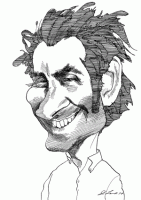
Drawing by David Levine, New York Review of Books
The only questions of importance were those which a man asked himself.
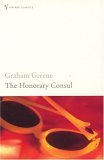
Another book that I have just finished is The Honorary Consul by Graham Greene.
The novel is set in Argentina. Oddly enough, in the obscure, northern town of Corrientes on the border with Paraguay. It’s the tragicomic story of a bungled kidnapping by a group of would-be revolutionaries who intended to kidnap the American ambassador as he toured the nearby Jesuit ruins but instead ended up with a drunken British honorary consul who owns a small yerba farm. The group holds the honorary consul hostage, having to supply him with endless amounts of whisky while they wait for their demands to be met by Paraguayan dictator General Alfredo Stroessner who can’t be bothered while on a fishing vacation in Patagonia. Meanwhile, the British diplomatic corps in Buenos Aires is puzzled why no one in Argentina understands that the captive is only an “honorary” consul and not a real diplomat, the “honorable consul”.
The story is told mostly from the perspective of Eduardo Plarr, a doctor in the small town who is the son of an English-Argentine marriage. The doctor’s mother spends her days in Buenos Aires shopping at Harrod’s and eating sweets at the Richmond.
Graham Greene is one of the greatest novelists of the 20th century. The Honorary Consul is almost a textbook example of narrative pacing and plot. Greene converted to Catholicism in his twenties and, like most of his novels, a priest makes an appearance towards the end of The Honorary Consul. The story comes to a grinding halt for a few pages while the defrocked priest discusses morality and theology of the story with the characters. Regardless, it’s still an excellent read, especially for anyone with even a passing familiarity with South America. Written when Greene was 69, he called The Honorary Consul “perhaps the novel that I prefer to all the others.”
Graham Greene obviously had visited Argentina and dedicated The Honorary Consul to his friend Victoria Ocampo: “For Victoria Ocampo with love, and in memory of the many happy weeks I have passed at San Isidro and Mar del Plata.”
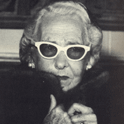
In the novel a pair of women’s sunglasses,worn by the honorary consul’s young wife, a former prostitute, figure prominently. Greene’s description of the sunglasses as well as the sunglasses pictured on the cover of the Vintage Classics edition remind me of the ubiquitous sunglasses that Victoria Ocampo wore in her later life, when Greene would have known her. I would like to think that Greene included the sunglasses in his novel as a small tribute to Ocampo.
The Vintage Classics edition, which is one of a series of Greene’s novels republished in 2004 on the centenary of his birth, includes an introductory essay by Nicholas Shakespeare who tells us that
It’s tempting to see in Charley Fortnum [the honorary consul] the projection of the frayed, seedy official that Greene might have become, sitting beneath a cracked portrait of the Queen while outside the Union Jack flutters upside down. Nobody wants “poor Charley” either. An old man and a drunk, he’s worthless in London, Buenos Aires and Corrientes. “All he has done for our relations with Argentina is to marry a local whore.”
Nicholas Shakespeare lived in Buenos Aires in the early 1970s when his father was actually the British Consul. Nicholas Shakespeare is the author of the splendid novel The Dancer Upstairs and a massive biography of Bruce Chatwin
 (who wrote the 1977 travel classic In Patagonia
 ).
).
Last week I went to KEL’s, an English language bookstore in Barrio Norte, to pick up some books that I’ve been wanting to read. I highly recommend J.M. Coetzee’s Disgrace , which I believe is the only 200+ page book that I’ve ever read in one afternoon. Other than Coetzee being from the southern hemisphere, he doesn’t have anything to do with Buenos Aires, so I’m not going more indepth into his works on this site.
A book that I’ve been putting off reading for a long time is The Hours by Michael Cunningham. Like a lot of people, I saw the movie and enjoyed it but I could never bring myself to actually read the book. Here’s the story why:
Back in graduate school, a young, intellectual woman I was courting (unsuccessfully) was visiting my apartment. Looking over my bookshelf, she said “That’s a well worn copy of To the Lighthouse .
.
I sat up in the chair. Then looking closer at the book, she said, “But it’s not your well worn copy”, having noticed the used bookstore label inside. I slouched back down.
Then I got up and went to the bookcase, “You might like this book, KATE VAIDEN by Reynolds Price. It’s told through the voice of a woman.”
She responded, “I don’t think men should do that. How do they know how to write like a woman? What it’s like to be a woman?”
That comment stuck with me for a long time, so whenever I thought about reading The Hours, which has three different women narrators, one of whom is the great novelist Virginia Woolf, I could never get beyond my friend’s comment. Finally, standing in KEL’s, I started to read some of the prose for myself and discovered that I really liked it. To hell with the gender of the author and characters.
Now, what does all this have to do with Borges and tigers? One of the epigraphs to The Hours is from the poem The Other Tiger by Borges:
We’ll hunt for a third tiger now, but like the others this one too will be a form of what I dream, a structure of words, and not the flesh and bone tiger that beyond all myths paces the earth. I know these things quite well, yet nonetheless some force keeps driving me in this vague, unreasonable, and ancient quest, and I go on pursuing through the hours another tiger, the beast not found in verse.
The epigraph to Cunningham’s novel is an uncredited prose translation of the Spanish, which is in verse:
Un tercer tigre buscaremos. Éste
Será como los otros una forma
De mi sueño, un sistema de palabras
Humanas y no el tigre vertebrado
Que, más allá de las mitologías,
Pisa la tierra. Bien lo sé, pero algo
Me impone esta aventura indefinida,
Insensata y antigua, y persevero
En buscar por el tiempo de la tarde
El otro tigre, el que no está en el verso.
I tend to prefer translations of poetry to remain in verse rather than prose. As comparison, here is a poetic translation of the same selection by Alastair Reid:
Let us look for a third tiger. This one
will be a form in my dream like all the others,
a system, an arrangement of human language,
and not the flesh-and-bone tiger
that, out of reach of all mythologies, paces the earth. I know all this; yet something
drives me to this ancient, perverse adventure,
foolish and vague, yet still I keep on looking
throughout the evening for the other tiger,
the other tiger, the one not in this poem.
That translation is included in the Penguin edition of Borges’ Selected Poems , which includes the Spanish version and English translation on facing pages for easy comparison.
Borges was fascinated with tigers and tigers appear throughout his works. In this poem the tiger represents the reality that the writer can never quite capture through words. According to his latest biographer, Borges wrote this poem just before his sixtieth birthday as an expression of the frustration with his own sense of failure as a writer.
Towards the end of the novel The Hours is a wonderful paragraph. One should know that “The Hours” was the original title that Woolf used for Mrs. Dalloway , the novel that figures so importantly in Cunningham’s book. It has been a while since I’ve seen the movie version but I think that these sentiments appear closer to the beginning of the film. I like it better as a closing and it’s clear why Cunningham won both the Pulitzer and the Pen/Faulkner award for The Hours:
Yes, Clarissa thinks, it’s time for the day to be over. We throw our parties; we abandon our families to live alone in Canada; we struggle to write books that do not change the world, despite our gifts and unstinting efforts, our most extravagant hopes. We live our lives, do whatever we do, and then we sleep – it’s as simple and ordinary as that. A few jump out of windows or drown themselves or take pills; more die by accident; and most of us, the vast majority, are slowly devoured by some disease or, if we’re very fortunate, by time itself. There’s just this for consolation: an hour here or there when our lives seem, against all odds and expectations, to burst open and give us everything we’ve ever imagined, though everyone but children (and perhaps even they) knows these hours will inevitably be followed by others, far darker and more difficult. Still, we cherish the city, the morning; we hope, more than anything, for more.

