March 2005
Monthly Archive
First-run movie tickets at the Cinemark in trendy Puerto Madero is $6.75 pesos, about $2.50 in US dollars. Taxi runs about $7 pesos for about a 4 miles trip. After the movie, we ordered food delivered from the restaurant next door to our apt: two entrees, plus tip to the delivery boy, was $14 pesos (under $5 US) for grilled chicken, puree, and spinach raviolis.
Buenos Aires lacks the outstanding colonial architecture of some Latin American cities, such as Lima or San Juan. Despite its presence on the Atlantic coast, Buenos Aires was never a major port for the Spanish empire and the major growth of the city didn’t start until well after the end of Spanish dominance in South America. The only remaining example of the colonial world in the city’s center is the Cabildo, a rather austere building that served as the mercantile center of Buenos Aires in the 1600s and 1700s. The present building has been rebuilt several times, with the current clock tower added as recently as 1940.
The main export from Buenos Aires in colonial times was leather and animal hides. Silver was actually banned from being exported here. This was due to the desire of Lima, as capital of the Spanish empire in the New World, to maintain its control on the territory. The primary silver mines were located around Potosi, which is now in Bolivia, though at the time that area was known as Upper Peru.
Properly, the term Cabildo refers not to a building but to the central authority of the Spanish empire in the colonial cities. The building Cabildo simply represents where that authority convened. The cabildo regulated prices on food and other goods, as well as wages. In BsAs, the Cabildo served as the main authority from 1580 to 1810.
A small museum is located within the cabildo. On Thursday’s and Friday’s, an artisan’s fair is held on the patio within the cabildo. While this fair is small in size, when compared to the larger weekend fairs in Recoleta, the quality of the crafts is among the highest to be found in the city.
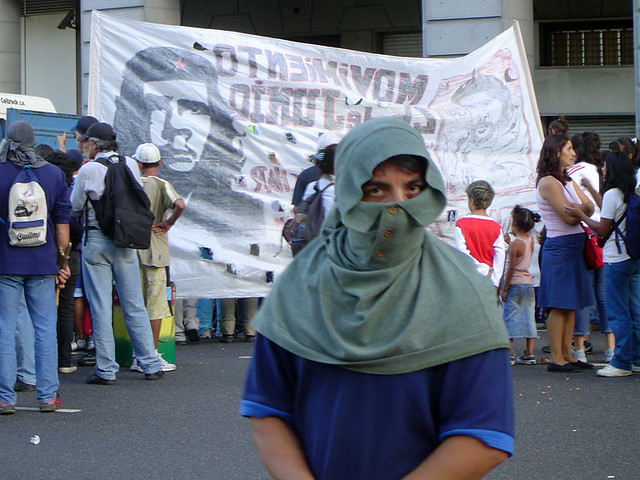
March 24 – This afternoon we started a walking tour of churches that was conducted by the tourism dept of the city of Buenos Aires. It was a special tour arranged for Holy Week and was part of a regularly series of free tours given every month by the city. The meeting point was the Basilica Nstr. Sr. de la Merced. A surprisingly large crowd showed up for the tour, approximately 50 people. This particular tour was given only in Spanish, though some of the other tours are also offered in English and Spanish. After we left the Basilica, we walked through Plaza de Mayo where we encountered a gathering crowd of demonstrators commemorating the 29th anniversary of the beginnings of the dictatorship on March 24, 1976. Figuring that the demonstrations were much more interesting than the Churches, which could be viewed anytime, we stayed around the Plaza as more and more demonstrators arrived. It was actually a peaceful demonstration despite the presence of the usual masked protestors armed with clubs and large sticks with their faces covered. Seemingly every aspect of Argentina´s modern protest movement was represented: representing the families of the disappeared, the piqueteros, the worker´s party, the student liberation movement, the communist revolutionary party, and a variety of smaller political fractions. Large-scale demonstrations have become an integral part of the fabric that one encounters on a fairly regular basis in BsAs.
March 22 (Miami International Airport) – Tonight I’m leaving Miami, my home for the past five years, for my new home in Buenos Aires. Writing that seems ridiculously surreal for a boy from a small town in Tennessee. It was five years ago, in March 2000, that I moved to Miami from Norfolk, Virginia where I had also lived for five years. (Interestingly, before Norfolk, I lived for five years in Knoxville. I wonder, am I a five year person?) As I was settling into my South Beach home five years ago, my girlfriend of the last three and a half years was in the process of moving to Miami from Buenos aires. Our paths in Miami wouldn’t cross for another 20 months.
In March 2003 Ceci moved back to BsAs. I traveled back with her then, my first trip to South America. Many more trips have followed over the intervening two years, nearly half-a-dozen trips to Argentina along with journeys to Uruguay, Brazil, Peru, and Venezuela.
This morning´s Miami Herald featured a color photograph of anti-American protestors in Buenos Aires, burning an American flag. Somehow, this seemed oddly ironic to see when I opened the newspaper on the morning of the day that I´m to leave for Argentina. However, I understood the context of the protest: Donald Rumsfeld´s visit to Argentina; there’s strong opposition to the war in Iraq among the Argentina population. Unlike my fellow Americans, the Argentines obviously didn’t believe that story about the weapons of mass destruction and are protesting the expanding Imperialistic behavior of the U.S.
The flights from Miami to Buenos Aires are nearly 9 hour flights. Tonight I´m on American Airlines, though my first back in 2003 was on Aerolineas Argentinas. Tonight, this will be my last flight for a while: I´m staying in Buenos Aires and going to call it home for a while.
So, sit back and let me tell you about my experiences in Buenos Aires, this city of faded elegance.