Last night I carried my two year old daughter down the steps of the Primera Junta subway stop in the neighborhood of Caballito. Mila had never ridden a subway before. I wanted her first experience to be on the wooden old cars of the A line. We’ve been intending to take her on that line for months, but the city’s recent decision to replace the wooden cars with new cars from China prompted me finally to create a memory for myself and my daughter.
We descended the steps to find an empty line of wooden cars encased in their steel frames waiting at the platform.
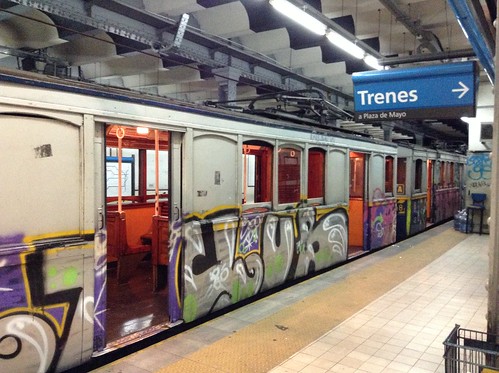
I wasn’t the only person feeling nostalgic. A couple of young guys milled around with very nice SLR cameras. Down the platform a woman posed in the window of one car while her husband snapped a photo. A few minutes later an older couple arrived with their grandchildren.
This particular train already was out of service. We waited across the platform for the next train. Unfortunately, the next train was not an old one but a partly now disastrous set of subway cars from the 1990s. So we waited some more. The next train was yet again a ’90s era model. I was beginning to get worried that the city had stopped the older trains a day earlier than announced. Mila at least enjoyed the graffiti splattered appearance of each train, then she thrilled with excitement as each train sped off. Another train came by with a “newer” set of cars. Finally, after about 40 minutes of waiting an old set of subway cars came to a stop.
These older cars don’t have automatic doors, so an older gentlemen slid open the entrance to the wooden car so that I could enter while carrying Mila in my arms. We found a seat and I took a few photos of her as the train left the station. With the movement she nestled in my arms. Initially, her face expressed a bit of concerned but then it she figured out everything was safe and fun while she looked around taking in everything. I held the iPhone in front of her and records several minutes of video of her enjoying her first subway ride. At only two she’s unlikely to actually remember taking this ride. But with the aid of photos, videos, this posting, and my telling her about this adventure in the future then perhaps she might be able to pull out fragments of this nightly ride on the last of the A line.
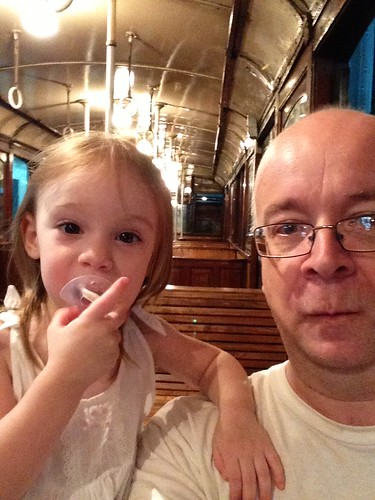
You’ll tell me years from now, my child, if you remember any of this night.
On Saturday I went on a photography tour that is a great way to experience Buenos Aires, and I strongly recommend that everyone place Fota Ruta high on a list of things to do in Buenos Aires. I put tour in italics since this turned out not to be a guided tour at all. Plus, it’s not just for photographers.

Every Saturday afternoon Foto Ruta has a gathering that explores a different neighborhood of Buenos Aires. This past weekend focused on San Telmo. The meeting location was a small restaurant on Balcarce. When I first got the email indicating the starting point I knew this was going to be slightly different from other encounters with touristic operations. Balcarce is one of my favorite streets in San Telmo but absent the large crowds that stream down Defensa. A few people were mingling in front of the resto when I arrived and a couple more soon joined. I was expecting Joss, one of the people who runs Foto Ruta, to appear, chat with us a for few minutes, and then lead us down the street. After all, that’s the typical walking tour routine.
Instead, we went into the restaurant where Foto Ruta staged a much bigger production than I imagined. On a table were nicely spread out several photography books for us to browse and an abundance of handouts, even including a lanyard (which doubled as a camera strap). I had to inquire who was their graphic designer since all the Foto Ruta publications were extremely well designed as is their website. Turns out the credit goes to Joss, who has a background in graphic design and photography. Her photographic understanding became even more evident as the afternoon went by.
The first forty-five minutes of the tour is spent sitting in the restaurant, which offered a good opportunity to get to know the others who have come on the tour that day. In my group were a guy from Iceland living in Sweden, two young women from the UK, and two other expats residing in Buenos Aires. Joss presented an overview of Foto Ruta, explained the concept of the tour, a brief history of the barrio, and then proceeded with a wonderfully illustrated presentation (on a large screen) about ways to compose better photographs that was filled with really useful advice and examples.
The innovative approach of Foto Ruta is that it’s not a guided tour showing you a dozen picture perfect spots for taking those quintessential photos of Buenos Aires. Rather, Foto Ruta is about helping you see beyond the touristic surface of a barrio and along the way you find the wonderful images that resonate with you. On a Foto Ruta excursion you go off on your own or with a small group if you so choose, then meet back at the restaurant in a couple of hours to review a selection of photos that everyone took that afternoon. To aid that process of discovery Foto Ruta provides a map, a list of useful phrases in Spanish, and, most importantly, a set of ten clues to stimulate your visual thinking. These clues are not the mundane “Find the old bar at the corner of Plaza Dorrego”, but a brief phase: Dorrego Daydreams. The interpretation is yours. And isn’t that the key to a great travel experience? We’re each internalizing our own encounters with a place. And photography can help express that in imagery.
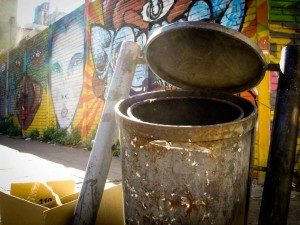
On Saturday I teamed up with Oli, the Icelander residing in Stockholm. That’s also the great benefit of Foto Ruta: a chance to make new friends. Over a couple of hours of wandering a neighborhood you have a lot of time to talk, maybe sit down in a cafe for a coffee. Oli turned out to have a fantastic eye for photography (not surprising that he carried two film cameras and one digital). Here’s a photo Oli took for the clue “A pigeon’s picada”.
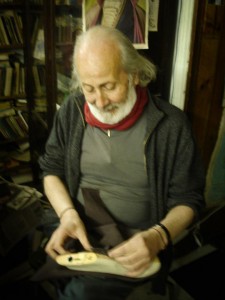
Even though I know San Telmo incredibly well, having lived in that barrio from 2005 – 2008, I still encountered new sights. And the neighborhood has changed in the last few years but much has remained the same. We wandered in a bookstore filled with old books. No other customers in the store but in the back was an old man with long white hair. After glancing at him I had to turn and look again at the object in his lap. He was making shoes. After a conversation it turned out that he’s a custom shoemaker who will measure your feet and craft a pair of shoes by hand. Stumbling across that type of encounter makes for a memorable afternoon.
Oli and I returned to the restaurant where Joss and her Finnish assistant Sari had bottles of wine waiting. The others soon arrived and everyone selected a photo that best matched each of the ten clues. Even if you’re not so into photography this made for a wonderful Saturday afternoon. You don’t even have to take photos; you can team up with another. And there’s no wrong answers when seeking out photos for the clues. You can be quite abstract and conceptual, plus most clues are quite broad and open to interpretation. As we’re sitting around drinking wine and chatting Sari copies the photos from everyone’s digital cameras and then Joss turns on the large screen monitor so that we can see the photos. Joss provides an excellent but gentle critique of the photos. This is not a graded exercise and she deftly finds something good to say about every photo. Indeed, some of the photos are quite remarkable. Check out the gallery page on Fota Ruta.
Seriously, if you’re into photography and you’re in Buenos Aires or visting the city then you’re going to enjoy the Foto Ruta experience. In addition to the Saturday excursions Foto Ruta also offers half-day and full-day workshops on street photography, a half-day on iPhoneography, plus a full-day post production workshop. That’s an exciting set of opportunities for anyone interested in photography.
I love Fota Ruta’s concept for getting people to truly experience the streets of Buenos Aires. You won’t learn anything about the history of a 19th century military leader and politician named Manuel Dorrego, but you’ll surely come away with lasting memories and new insights in photography.
Sitting at my desk today I’ve been hearing the voices of tango singers floating up towards my 7th floor balcony. With hundreds of other apartments visible from my window I assumed a neighbor had taken on a new obsession & had started a practice of playing the stereo extremely loud. Eventually a slight tone made me realize that this was no recording but live music. How I’ve not kept up with the happenings around town. The annual tango festival is taking place. A quick visit to the city’s website revealed that the focus of today’s events are at the amphitheater in Parque Centenario. The entrance to the theater is a direct line of sight from my balcony. If I didn’t have some very pressing matters at work then I would hop over to the festival. Meanwhile, I’m listening to music from afar. It’s quite enjoyable to have the sounds of live tango drifting into your Buenos Aires apartment.
Last Friday for the May 25 holiday we ventured out to San Telmo (how I miss living there) to dine at El Histórico. (I forgot to bring a camera.) We enjoyed the food very much & the building is fascinating. It deserves an entire post all about the place, but I don’t have time for that now. Meanwhile, here’s an article about restaurante El Histórico with photos & video from perfil.com.
Mila (who is 17 months old today) enjoyed it, also. We went early & were actually the only customers in the restaurant for most of the time. Who eats dinner in Buenos Aires at 8pm?! Well, that’s helpful when out with a very young child. Since we had the whole place to ourselves, I carried Mila in my arms and showed her around. She pointed out a lot of different artefacts & asked questions in her soft, babbling baby voice.
To celebrate the long holiday weekend here in Argentina & the U.S. (as well as my return to blogging about Buenos Aires) the 4 Days in Buenos Aires app for iPhone is free for this weekend.
And, if you’re into apps, you’ll definitely enjoy the Recoleta Cemetery iPhone app. You’ll have to buy that one, but it’s worthwhile.
A friend of mine says, “The most heroic task of a parent is getting their child to sleep each night.” Ah, that’s a challenge. Mila & I have our routine. It’s changes every few months. The process usually takes about 45 minutes. (Yes, to those of you without children: parenting takes a lot of time.) After she falls asleep I stay with her for a few minutes to make sure she drifts into a deep slumber. Otherwise I’m rushing back to the bedroom to soothe a screaming toddler who can’t understand why she’s along in the crib. (We tried the “cry it out” method and that didn’t work.)
On this night, just as Mila entered her sleep zone, a frenzied roar echoed across the barrio as a football game ended. A fan in our building sounded as if he himself had been unleashed onto the playing field. All the while I made humming sounds into my little girl’s ear in hopes that she wouldn’t stir. The magic held and her rest continued undisturbed. (Her mother once fell asleep during a University of Miami football game…in the stadium..the Orange Bowl. A different kind of football, but maybe Mila will have the same indifference to it as her parents. We’ll leave that to her, though we hope she doesn’t become a botinera [one of those girls who pursue football players for the moneyed lifestyle…do a Google image search on botinera if you need a visual reference.])
Oh, and the ball game. Evidently it was quite a big game as a tournament is underway. I should follow the sport more often but unless it’s the World Cup I’m really can’t muster the enthusiasm.

The inactivity on this blog was largely due to my absence from Buenos Aires for 2010 & 2011. I spent that time down on the coast of Argentina in a very small place called Mar del Sur, which proved far too small. We then moved over a bit to the larger town of Miramar. (Oh, and along the way we had a baby girl.)
At the end of 2011 we moved back to Buenos Aires, but work and parenthood is keeping me busy. I’m not sure yet how I will continue writing about Buenos Aires. My experiences in the city are very different than six or seven years ago when this blog was in full swing. No longer is there time for those long, rambling walks around the city. I rarely get out of the neighborhood these days.
We’ll see if I can return to an occasional presence on this blog.
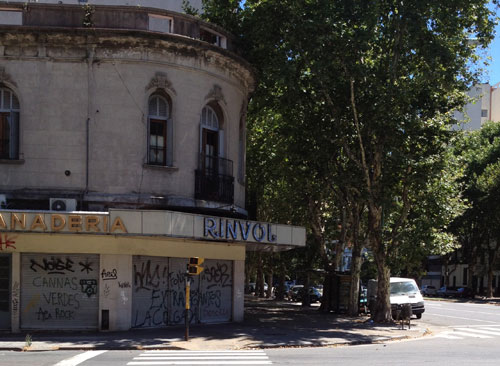
Without a doubt, Recoleta Cemetery is the most enchanting spot in Buenos Aires. Even after dozens of visits I still discover a new aspect: a tomb gone unnoticed or the slant of light through stained glass. Indeed, the cemetery is different depending upon the time of day and weather. And there’s all that history of Argentina represented among the dead.
Wandering the cemetery on one’s own is always a pleasure. Back in 2007 I had the opportunity to take a tour of Recoleta Cemetery with Robert Wright, who led tours not just of the cemetery but elsewhere in the city. But Robert no longer provides those tours. Robert and I teamed together to form Endless Mile, an initiative to create a set of digital guidebooks to Buenos Aires and other cities.
Our very first guide is to Recoleta Cemetery. Our guidebook to Recoleta Cemetery is available either as an app for iPhone & iPod Touch.
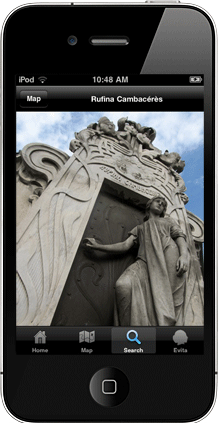

This app is no longer available
With the Recoleta Cemetery app or e-book you will get a guided walking tour with insightful entries about the 25 most important tombs, along with over 70 color photos & archival images. Plus, the fascinating history behind what happened to Eva Perón’s body is explained.
I wished I had this guidebook on my very fist visit to Recoleta Cemetery in 2003. But this guide is not just for taking a walking tour. It’s also a vivid way to remember your visit & share with others the extraordinary place that is Recoleta Cemetery.
My personal recommendations (a tiny guidebook, if you will) for enjoying 4 perfect days in Buenos Aires: also available as an app for iPhone. You also can use it on your iPod Touch or iPad.
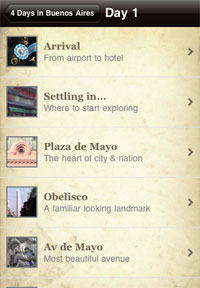
So, take a look at my first app-based travel guide to Buenos Aires.
It’s amazing what you an get for a .99 cents, especially in Buenos Aires. And, hey, if you don’t want the app then go spend those a buck on a cup of coffee over at my favorite place: Bar Británico.
The app Buenos Aires in 4 Days is available on the iTunes app store.
This app is no longer available
One of the things that keeps me too busy to blog often here is my work with The International Literary Quarterly, also known as Interlitq. One of the exciting developments with the literary journal over the past year is the inclusion of more works by authors writing in Spanish, such as Argentine writers María Teresa Andruetto, Marcelo Cohen, Eugenio Conchez, Patricia Delmar, María Negroni and Ana María Shua; Chilean writers Carla Guelfenbein, Lina Meruane, Hernán Neira, Nicolás Poblete, Cynthia Rimsky, and Mauricio Wacquez; as well as works in Spanish by Luis
Cernuda, Rubén Dario and Rosalia de Castro.
The interest in Spanish-language literature stems from the fact that several members of Interlitq’s editorial board have ties to Latin America. Founding Editor & President Peter Robertson has been resident in Spain and Argentina for the last fifteen years and is also starting to spend more time in Monterrey, Mexico; Beatriz Hausner (the General Editor) is originally from Chile; consulting editor María Teresa Andruetto as well as assistant editors Eugenio Conchez and Patricia Delmar are all Argentines. And, of course, I am an American based in Argentine and serve Interlitq in the capacity of Deputy General Editor.
A visit over to Interlitq’s Palermo offices, just around the corner from Parque Las Heras, finds Peter Robertson availing himself of a lull in frenetic activity to sip a glass of Malbec as he describes the shift in direction for Interlitq, “While as many as 84% of our readers come from the U.S., Interlitq now has one eye firmly trained on literature being written in Spanish. Publishing extensively in Spanish was just a matter of time for us. While we will continue to publish literature in many different languages, Interlitq now perceives itself as being essentially a bilingual publication, in English and in Spanish. And let me be clear that Interlitq is interested not only in publishing established authors writing in Spanish but also new, unheralded voices. To this end, a few weeks ago we initiated an open submissions policy at Interlitq, so that everyone, whether writing in Spanish or in English, is welcome to send us their work for appraisal”.

In June 2011 Interliq will publish a major feature on Panamanian literature. Robertson explains, “This venture is very exciting for us as it will be our first major feature in Spanish. And so far I am delighted to confirm that the prose writers: Lissete Lanuza Sáenz, Gloria Melania Rodríguez, Lili Mendoza, Annabel Miguelena V., Klenya Morales, Roberto Pérez Franco, Melanie Taylor and Carlos Wynter Melo; and the poets Javier Alvarado, Magdalena Carmargo Lemieszek, Edilberto González Trejos, Eyra Harbar, Gorka Lasa Tribaldos, Salvador Medina Barahona and Javier Romero Hernández have all committed to this project”.
Preparing to return to the task of evaluating texts for possible inclusion in Interlitq, Robertson winds up by saying, “With all of these writers on board, this Panamanian feature will set the stage for further features to be published by us in Spanish. Furthermore, we at Interlitq are fascinated by the idea of cultural intersections and linguistic confluences; for example, showcasing the writing, in both English and Spanish, coming out of New York would certainly make for a fascinating project. And, while we did already publish a feature on Miami in Issue 13 of Interlitq (“15 Miami Poets”) we would be interested in the possibility of returning to that city later in 2011, so as to provide Miami with a more extensive platform for its anglophone and hispanophone voices, and its ethnically diverse artwork”.
Interlitq always has aimed at publishing works in more than English. The most notable example is the Volta project featuring one poem along with its translation into more than 90 languages.
The International Literary Quarterly is a not-for-profit corporation (New York) and was founded in 2007. For details about submissions, whether in Spanish or in English, please see the guidelines.
Next Page »