This is the last day of my “30 days with Borges” series. It has been fun being absorbed into the world of Borges and writing these posts. (Sorry that some have been very long but I’ve not put any effort into editing). While this is the last day of the series I will continue writing posts about Borges but with less frequency. There are a lot of other great literary aspects of Buenos Aires that I will be covering, in addition to more about Borges. Also, welcome to the new readers of this blog that have come about through these postings. I half expected the readership of this blog to plummet during this series but it has remained steady and even increased slightly. So, a special thanks to loyal readers who have stayed.
I like El Sur so much that I chose it as the domain name for my Web site. Actually, a few other things went into that decision but the story title did have a lot to do with it. El Sur is set in February 1939 about a librarian named Juan Dahlmann who has a number of similarities to Borges himself. The story has some of the best descriptions by Borges of Buenos Aires and the pampas.
There’s an incident in the story that occurred in the real life of Borges. We are told in the story that Dahlmann had hit his head on a “recently painted casement window that somebody had forgotten to close”. That actually happened to Borges on Christmas Eve 1938.
Borges was seriously injured and spent a week lying in bed, delirious with insomnia and hallucinations. One night he lost the ability to speak, was rushed to the hospital for emergency surgery and spent a month near death. After he recovered, Borges entered the greatest period of his writing career. I often wondered what went through his mind during his sickness and how it impacted his later writings. El Sur gives us some hint of that.
But I want to focus on the part of the story where Juan Dahlmann arrives in a cab one morning at Constitución station to take the train:
“The first cool breath of autumn, after the oppression of the summer, was like a natural symbol of his life brought back from fever and the brink of death. The city, at that seven o’clock in the morning, had not lost that look of a ramshackle old house that cities take on at night; the streets were like long porches and corridors, the plazas like interior courtyards.
La primera frescura del otoño, después de la opresión del verano, era como un símbolo natural de su destino rescatado de la muerte y la fiebre. La ciudad, a las siete de la mañana, no había perdido ese aire de casa vieja que le infunde la noche; las calles eran como largos zaguanes, las plazas como patios.”
On the way to Constitución Borges mentions something that everyone learns when navigating the streets of Buenos Aires, that the streets change names at Av Rivadavia. But Borges goes on to describe how the southside (el Sur) of the city is different. That is still very true today.
“Everyone knows that the South begins on the other side of Avenida Rivadavia. Dahlmann had often said that that was no mere saying, that by crossing Rivadavia one entered an older more stable world. From the cab, he sought among the new buildings the window barred with wrought iron, the door knocker, the arch of a doorway, the long entryway, the almost-secret courtyard.
Nadie ignora que el Sur empieza del otro lado de Rivadavia. Dahlmann solía repetir que ello no es una convención y que quien atraviesa esa calle entra en un mundo más antiguo y más firme. Desde el coche buscaba entre la nueva edificación, la ventana de rejas, el llamador, el arco de la puerta, el zaguán, el íntimo patio.”
Estación Constitución is a beautiful old train station that is still the railway gateway to points south of the city. Having time before his train leaves, Dahlmann heads over to a cafe on calle Brasil. Borges makes reference to the cafe being a few yards from the house of former president Hipólito Yrigoyen.
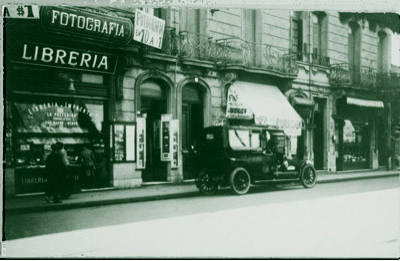
Yrigoyen was a figure that dominated the Argentine politics in the early part of the 20th century, serving as president from 1916 – 1922 and again from 1928 till a military coup overthrew the government in 1930. Up till the last year of his presidency, which coincided with the worldwide economic depression, Yrigoyen was very popular. Crowds of supporters would gather in front of his house on calle Brasil. Among his most enthusiastic supporters was Jorge Luis Borges. After the coup, Yrigoyen’s house was ransacked by his opponents. Including a brief mention of the house in this story must be an homage from Borges to Yrigoyen.
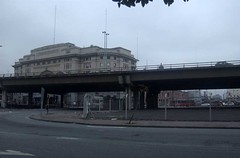 I live on calle Brasil, just a couple of blocks from the spot where Yrigoyen’s house was located. The house was torn down a few years after the coup in order to make way for road construction. Now, as you can see in the photo, a highway overpass runs over calle Brasil on the block where Yrigoyen lived. You would never know anything historic was ever there. That’s Constitución station in the background, which you can hardly see.
Side note: The story is set in 1939 but I’m not sure at which point Yrigoyen’s house was torn down. I once read somewhere (that I’ve now misplaced) that it was torn down in the 1930s for the construction of Av 9 de Julio, which means that it would not have been there in 1939. Borges would have known that and possibly included the reference to the house for that very reason. But perhaps it was demolished later when the highway was constructed?
Update: I’ve been looking at some aerial photos of this area from the 1940s, the 1960s and 1978. I cannot exactly pinpoint the Yrigoyen house but I have realized that this block was not demolished until the 1970s.
Borges describes Dahlmann thoughts about a cat that lives in the cafe visited by Dahlmann:
“He ordered a cup of coffee, slowly spooned sugar into it, tasted it (a pleasure that had been forbidden him in the clinic), and thought, while he stroked the cat’s black fur, that this contact was illusory, that he and the cat were separated as though by a pane of glass, because man lives in time, in successiveness, while the magical animal lives in the present, in the eternity of the instant.
Pidió una taza de café, la endulzó lentamente, la probó (ese placer le había sido vedado en la clínica) y pensó, mientras alisaba el negro pelaje, que aquel contacto era ilusorio y que estaban como separados por un cristal, porque el hombre vive en el tiempo, en la sucesión, y el mágico animal, en la actualidad, en la eternidad del instante.”
On calle Brasil today one can still find a cafe where a cat lives. In Bar Britannico, on the corner of Brasil and Defensa, look around for the cat that is usually asleep under a table or in one of the chairs. Every time I go in there I think of the cat in El Sur. Update: See my comment #4 below.
Afterwards, Dahlmann takes the train out to the pampas:
“Outside the moving shadow of the train stretched out toward the horizon. The elemental earth was not disturbed by settlements or any other signs of humanity. All was vast, but at the same time intimate and somehow secret. In all the immense countryside, there would sometimes be nothing but a bull. The solitude was perfect, if perhaps hostile, and Dahlmann almost suspected that he was traveling not only into the South but into the past.
Afuera la móvil sombra del vagón se alargaba hacia el horizonte. No turbaban la tierra elemental ni poblaciones ni otros signos humanos. Todo era vasto, pero al mismo tiempo era íntimo y, de alguna manera, secreto. En el campo desaforado, a veces no había otra cosa que un toro. La soledad era perfecta y tal vez hostil, y Dahlmann pudo sospechar que viajaba al pasado y no sólo al Sur.
So far, the story is really a setup for Dahlmann’s adventure in the pampas, which I will leave for you to read. There are the typical features that Borges loved…the country store, knives, and gauchos.

 It has been a long time since reading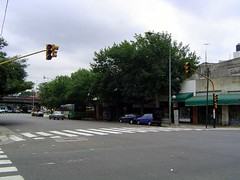
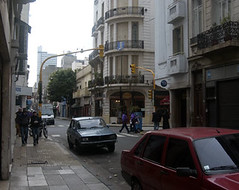
 Published in his 1981 poetry collection La Cifra, The Limit, when Borges was in his eighties. The actual title of this poem in the original Spanish version is also the English word Yesterdays. Here are some selected lines: