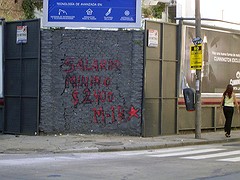
Just a scene from an early morning walk around Barracas….
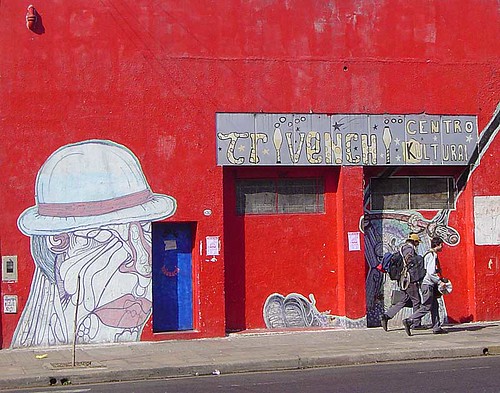
Just a scene from an early morning walk around Barracas….
Continuing with our look at the political posters for the upcoming city elections….
This has to be one of the oddest political posters around town. At first, I thought it was a pro-Macri poster with its big letters of “Vote Macri” but I was confused since I didn’t know my Macris too well. Did Macri shave off his mustache? Did he lose it jumping over a pothole?
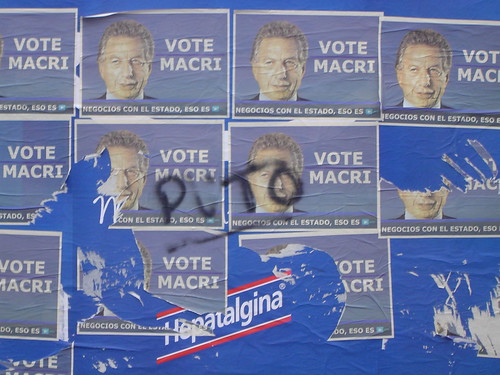
Then it was pointed out to me that this photo is of Macri’s father – Franco Macri, a local business tycoon with a dubious reputation.
The slogan underneath the photo says “Business with the state, that is” followed by the symbol for Macri’s political party PRO. The elder Macri made a lot of money from doing business with the state. The poster implies that a Macri government will be filled with corruption.
Then again, conservative business types might just be in full agreement that business with the state is the way to go.
Do political advertisements in Argentina have to include a statement as to who funded the ad? I don’t think so but it would be very interesting to know in the cases of many the posters.
Oh, I almost forgot…as you see in the photo…someone added a derogatory statement over the posters of Macri…since this is a family blog, I’ll leave the translation out.
From all the signs hanging on the outside of buildings, this must be the time to sell in San Telmo. (I count 9 for sale signs in this photo). I just wish that someone would go ahead and buy all those buildings so that they can take down those for sale signs and return the streets to normal. All the signs are messing up everyone’s photos of these lovely streets.
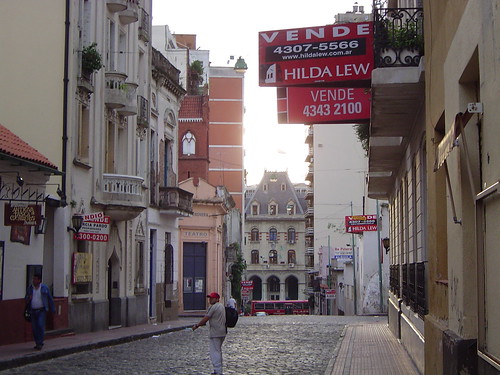
Actually, there’s a building down the street from me on Av Caseros that was sold over six months ago and the “for sale/sold” signs are STILL hanging all over that building. Enough!
Walking somewhere along Chile I came across this new stencil, imploring that San Telmo not become Palermo.
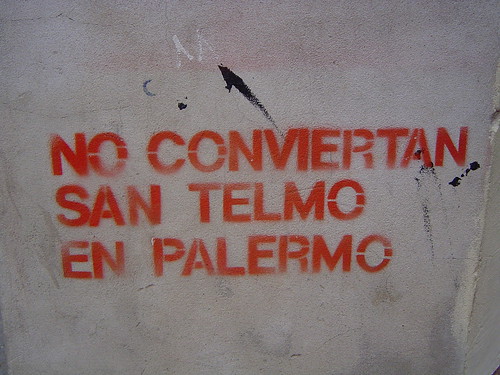
But I think that it’s a lost cause. At least San Telmo has more interesting architecture than Palermo.
[Note the date on this post is from 2007.]
Everybody is grumbling about inflation in Buenos Aires these days…..painted on the corner of Brasil and Piedras is this demand for minimum salaries of 2,400 pesos. Somehow I think that there’s more to this statement. (I missed the posters that also were on the street a few days earlier attempting to rationalize this statement). But I know very few people in Buenos Aires who are making 2,400 pesos a month.
It’s political season again here in Buenos Aires with the city’s elections just a couple months away. That means posters are popping up all over the city. Here’s one from Daniel Filmus suggesting that a vote for him is a vote for a cleaner city.
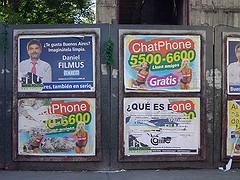
I wonder if they only put that poster on the filthy streets…anyway, I suspect more people were noticing the Chat Phone posters surrounding it. More posters from all your favorite candidates coming soon.